Showing posts with label japanese foods. Show all posts

Sunday, January 27, 2013

Before you eat: Japanese dining etiquettes and taboos

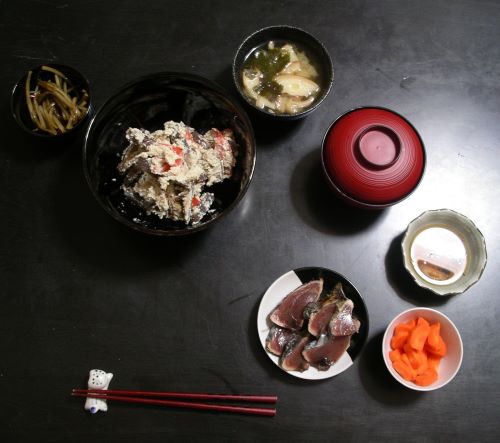
Image Source: MyCrazyBuffet.com

Japanese culture is centered on politeness, respect, and graciousness. Such reverence and refinement is observed not only in how they treat each other, but also in their manner of eating and dining.

For those who are foreign to the table manners and dining taboos of Japan, there are some essential things to keep in mind before eating Japanese food.

At the beginning of the meal, the Japanese bow and position their hands in a Namaste manner and politely say “Itadakimasu” which means “I gratefully receive.” This gesture is an expression of gratitude and appreciation for the collective efforts made by many in the preparation of the meal.

Image Source: ChopstickEtiquette.com

It is customary for the Japanese to use chopsticks, and one of the most fundamental elements of Japanese table manners is the proper use of chopsticks. When there is shared food, the ends of the chopsticks which are not used for eating are usually used to take food from the shared plate. The other end is used for eating and should not be used to pick up shared food. In addition, it is taboo to stick the chopsticks into the rice. In Japanese tradition, sticking chopsticks into the rice is done only at the funerals.

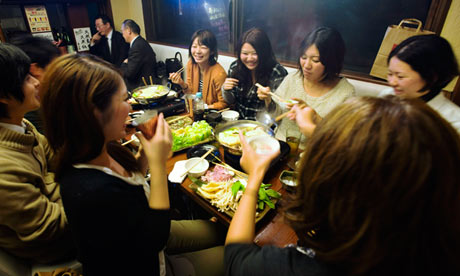
Sharing food is also common in Japanese dining. In fact, it is practiced in private households and in restaurants such as an izakaya. When sharing food, it is proper to place a morsel of food onto a small plate and then pass the dish to another person. Passing food from chopstick to chopstick is an offensive gesture as it resembles the Japanese’s funeral tradition of cremation wherein the bones of the deceased are handled in almost the same fashion.

Image Source: Guardian.co.uk

When eating rice, the rice bowl should be held close to the mouth. This is done to avoid spilling the rice. It is also considered rude to pour an excessive amount of soy over the rice. Instead, a small amount of soy should be poured onto the dish, not on the rice. When eating sushi, it is expected that one will eat it in one bite. Separating or cutting the sushi into halves destroys the beautifully prepared sushi. Slurping is allowed when eating noodles; however it is not a universally practiced Japanese etiquette. In fact, it is considered offensive similarly with blowing one’s nose at the table.

To end the meal, one should always express gratitude by saying “Gochisosama deshita” or “Thank you for the meal.”

JC Uni-tec provides kitchen equipment perfect for making Japanese dishes. This blog offers more topics on Japanese cuisine.

Tuesday, December 25, 2012

The Japanese-Style Meal: Planning and Preparation

Discover the secrets of Japanese style meal planning and preparation in this Kikoman.com article.


In the 1970s, the daily diet revolved around the so-called Japanese-style meal—nutritionally balanced foods that arguably define Japanese cuisine. In our current Feature series, we take an in-depth look at these meals, including their planning and preparation.


The Ideal Ichiju San-sai

The Japanese-style meal involves some planning. The traditional menu is described as ichiju san-sai, or "one-soup, three dishes," and features soup, one main dish and two side dishes. Not counted but always served with these are rice and konomono, pickled vegetables.

Meal planning takes its cues from nature, and incorporates fresh seasonal ingredients. One begins with the staple, typically plain rice, or rice with seasonal ingredients added, such as bamboo shoots in Spring or chestnuts in Autumn.

Following this is the main dish, which usually contains a substantial amount of protein such as meat, fish or tofu. Examples are grilled or sautéed fish; yaki-niku (grilled meat); tonkatsu (pork cutlet); or agedashi-dofu (deep-fried tofu with soy sauce-based sauce garnished with ginger and green onion). Each of these would be accompanied by vegetables or some kind of potato.

Next are the two side dishes, for which one chooses vegetables not included in the main dish, prepared using a different method. Additionally, care is taken not to duplicate the ingredients or preparation methods of either of the side dishes themselves. The ingredients and flavoring of the soup, finally, should complement all three dishes.

A typical ichiju san-sai menu might include salt-grilled fish as the main dish, and miso soup with tofu and wakame (kelp). One of the two side dishes might be chikuzen-ni, whose ingredients of chicken, carrots, burdock, lotus root, sato-imo (taro), and konnyaku (yam cake) are sautéed together and then simmered. The remaining side dish could be goma-ae, blanched spinach with sesame dressing. The meal is accompanied by rice and konomono such as salt-pickled Chinese cabbage.

The main dish might be changed to one of meat and vegetables, while the second side dish—in this case goma-ae—could be replaced with a salad or with sunomono (a vinegar-marinated dish) made, for example, with cucumbers and wakame.

By choosing seasonal vegetables for as many of the dishes as possible, and by varying preparation methods—grilling, boiling, simmering, mixing with dressing (aemono), marinating with vinegar, and so on—the basic menu accommodates great variety.


Nutritional Balance

How well-balanced are such menus? If we use a current food composition table to calculate the nutritional value of the above menu, we find that rice (one-and-a-half bowls totaling about 80 grams), salt-grilled salmon (one slice at 70 grams), and individual servings of chikuzen-ni, goma-ae and miso soup, provide a total of some 620 kilocalories, which is roughly equivalent to one-third the recommended standard daily calorie intake for an adult woman.

The amount of protein is slightly high at 32 grams, and the fat intake is an almost appropriate amount of just over 25 percent of total calories. Moreover, this meal offers 35 percent of the recommended standard daily intake of calcium, which is relatively difficult to obtain; about the same percentage of vitamin C; and the appropriate amount of minerals. It also provides the recommended daily intake of vitamin A (retinol), most of this sourced from the carotene of vegetables such as carrots and spinach. Forty percent of the fats come from plant-derived foods, mostly sesame, and these are all very healthy.

The amount of rice consumed may be adjusted as appropriate for gender, age and level of physical activity. An appropriately balanced diet is therefore relatively easy to achieve by eating meals comprising rice with soup and three accompanying dishes.


Cooking Methods

The cooking of Japanese-style meals requires a fair amount of clean water. Rice is rinsed to wash away remaining bran prior to steaming; spinach for the side dish is blanched in boiling water, then plunged into cold water to preserve its fresh green color. In preparing raw fish for sashimi, plenty of water to wash the fish is indispensable.

Water is also needed to simmer or steam foods, such as niku-jaga (simmered meat and potatoes) or chawan-mushi (steamed egg custard); even when serving chilled tofu (hiya-yakko), the tofu is chilled in cold water and the accompanying green onion and ginger garnishes require water in their preparation.

Because Japanese-style meals are eaten with chopsticks, skill with kitchen knives is considered of great importance. Japanese kitchen knives are traditionally single-beveled, thought to help retain flavor in slicing fish for sashimi, for example. Although professionals use single-beveled knives, many households today use double-beveled, Western kitchen knives.

Many dishes call for ingredients to be cut into very thin, uniform strips or bite-sized pieces, and so a good cutting board is as indispensable as the proper cutting technique: cucumbers and daikon radish, for example, are often sliced very thin, and the white stems of long onions are precisely cut into long, fine, delicate strips called shiraga-negi, used as garnish.

Until recently, the Japanese-style meal was also the norm for breakfast in most homes: children would wake to the rhythmical sound of their mother's knife chopping vegetables, accompanied by the fragrance of miso soup.

Although ingredients differed from one family to another and each had its own favorite tastes, the basic styles of eating were repeated every day, and standard cooking techniques were mastered and used in all households. The recollection of such meals brings back warm memories for many.  

Source:http://www.kikkoman.com/foodforum/thejapanesetable/30.shtml

Sunday, December 16, 2012

Cooking Methods


This article from Yale Center for International and Area Studies give some useful facts about Japanese cooking and table setting.
 
Japanese food is all cooked on the stove-top; an oven is never used. There are five traditional cooking methods: boiling, grilling, deep-frying, steaming, and serving raw. "Serving raw" is considered a cooking method because although the food is not cooked, preparation (in terms of peeling, slicing, etc.) is still required.

The ideal Japanese meal has at least one dish cooked in each manner. Color is also a factor; there are five colors: green, yellow, red, white and black. "Black" means the dark purple of an eggplant or some kinds of cabbage. The ideal meal involves a balance of these colors, cooking methods, and a balance of the six tastes: bitter, sour, sweet, hot, salty, and mild.

In addition to the importance of setting a proper place, which is equally important in the West, the arrangement of the food on the plate itself is also important: dishes are filled to two-thirds their capacity. One reason for this is to not obscure the pattern on the surface of the dish.

 Table Settings

In setting a Japanese table, the location of dishes and utensils is as important as it is in Western cuisine. The diagram below shows a general schematic for a table setting.


This arrangement may differ slightly: for example, when noodles are served, the noodles themselves go where the soup usually goes, and the dipping sauce goes where the rice usually goes. This is because the noodles are often eaten after dipping in the sauce-that is when they are left.

The principle difference between the Japanese arrangement and the western arrangement is that in the American arrangement, the meat is always placed directly in front of the eater; in Japan, the meat is placed off to the right. Another difference is that chopsticks are placed directly in front of the eater, instead of off to the side like silverware in the western tradition.

The examples below show some sample table settings that vary from season to season. Usually, the pattern of the dishes is changed according to the season-for example, maple leaf-pattern for the fall, plum blossom-pattern for spring-as well as the type of food served.


Source: http://www.yale.edu/macmillan/pier/resources/lessons/cooking_table.htm

Wednesday, November 28, 2012

Food Truck Bite of the Week: I Sushi, You Sushi, We All Sushi


This SF Weekly blog talks about one of the favorite Japanese foods around the world - sushi.

Our weekly bite explores the city's food trucks, one at a time, highlighting our favorite mobile dishes and snacks.

The Truck: We Sushi  
The Cuisine: Japanese-California rolls and bowls
Specialty Items: Deep-fried rolls and chirashi sushi rice bowls  
Worth the Wait in Line? On an overcast day, it was a total 10 minutes from the end of the line to food in hand.

The very nature of sushi, and the consumption of raw fish, inspires some inherent mistrust in certain situations. Discounted late night sushi at a 7-11? Probably not a great idea. While your risk-adverse brain (it is just doing its job) may categorize sushi off a food truck at a similar risk level, We Sushi surprised us with the freshness of the fish, portions, and value.

See Also:
- Flying Southern for the Winter
- ICHI Sushi's Tai Nigiri
- Is American Sushi on the Decline?


The menu of rolls, including sushi "burritos" dominates half of the menu, along with deep fried items like their popular Lobster Crunch ($8, lobster salad, cucumber, avocado, yuba aka tofu skin). Tossed in a tobiko spiked dressing, the nice chunks of lobster meat and veggies get wrapped in yuba, coated in tempura batter, and deep-fried. While it was crunchy, generously portioned, and a nice combination of ingredients, it's a dish best reserved for those days with an open calendar, i.e., able to sneak a nap under your desk.

The simple beauty of the Chirashi ($9.50, assorted sashimi and vegetables, sushi rice) bowl seemed to highlight the freshness of the fish the best. A warm bed of seasoned sushi rice with just enough sweet-salty-tangy flavor contrasted nicely with the large slabs of salmon, hamachi, albacore, and what we guessed was probably snapper (we forgot to ask), a small tangle of some amazing seaweed salad fragrant with sesame oil, cucumber batons, and the usual ginger and wasabi. While we wished the fish came sliced thinner and in bite-sized pieces, the fish was fresh, and the price amazing for the portions. A spicy version is also available, though the fish is chopped and mixed with a spicy mayo sauce; not quite as light or visual striking.

A filling-yet-revitalizing meal is a rare feat for food truck fare, but like Liba Falafel's wonderful salads, We Sushi's chirashi manages to expand your food truck options to something delicious you won't feel bad about eating.

Source: http://blogs.sfweekly.com/foodie/2012/11/food_truck_bite_of_week_we_sushi.p